
Kinkaku-ji history at a glance
The temple's formal name is Rokuon-ji. Most people call it Kinkaku-ji after its main building, the Kinkaku, a three-storey reliquary hall covered in gold leaf on its upper two floors. The temple belongs to the Rinzai school of Zen and is a branch temple of Shokoku-ji.
Kinkaku-ji history has three chapters. First the site was an aristocratic estate, then the villa of the shogun Ashikaga Yoshimitsu, and after his death a Zen temple. In 1950 the pavilion burned down completely. The building you look at across the Kyoko-chi pond today was rebuilt in 1955 and regilded in 1987. Kyoto's history also shows in its old geisha district, where Gion has wooden townhouses and tea houses.
Before Yoshimitsu: an estate in the northern hills
Long before the Golden Pavilion, Saionji Kintsune laid out a villa with a temple on this land in the northwest of Kyoto. Its dedication dates to 1224, and Teika visited in 1225. So when Yoshimitsu chose the site more than 170 years later, he was building on ground that already had a long history as a country retreat.
If you want the stories behind the buildings rather than just the view, a guide helps. Our page on Kinkaku-ji tours compares small-group walks with entry included and longer Kyoto day tours that stop here.
Ashikaga Yoshimitsu and the Kitayama villa
The shogun Ashikaga Yoshimitsu was born in 1358. In 1394 he handed the office of shogun to his son Yoshimochi. Three years later, in 1397, he began building his Kitayama villa on the old Saionji estate. The golden reliquary hall was its centrepiece.
In Yoshimitsu's building the ground floor held a Shaka triad, the middle floor served as a Kannon hall and the top floor held relics of the Buddha. That describes the pavilion as Yoshimitsu planned it, not a list of what is inside today.
In 1408 the emperor visited the villa. Yoshimitsu died the same year. Following his wishes, the villa became a Zen temple, and the monk Muso Soseki was named its founding abbot after the fact. The temple belongs to the Shokoku-ji branch of Rinzai Zen.
The three floors each follow a different building style: the ground floor in the shinden style of aristocratic residences, the second floor in the samurai buke style and the top floor in a Chinese-influenced Zen temple style. Read more about the architecture on our Golden Pavilion page.
Our pick: a tour through the temple's history
The guide tells the history of Kinkaku-ji as you walk, and the entrance fee is covered.
Hand-picked tours, booked through Viator. Prices are indicative starting prices in US dollars (as of October 2026). Tap a tour for live availability and the current price in your currency.
Guided Kinkaku-ji tours with the history explained
Small-group temple walks with admission, historical guided tours and Kyoto day tours that stop at the Golden Pavilion, with live prices and availability.
The pavilion before the fire
Kinkaku-ji before the fire was Yoshimitsu's reliquary hall, standing on the pond from Yoshimitsu's time until 1950. During the Meiji period it was taken apart and repaired, a dismantling repair completed in 1904. The records from that work later became the basis for the rebuilding.
The rebuilt pavilion is a reconstruction, not the medieval building, and that is worth knowing when you stand on the shore of the Kyoko-chi.
The 1950 fire
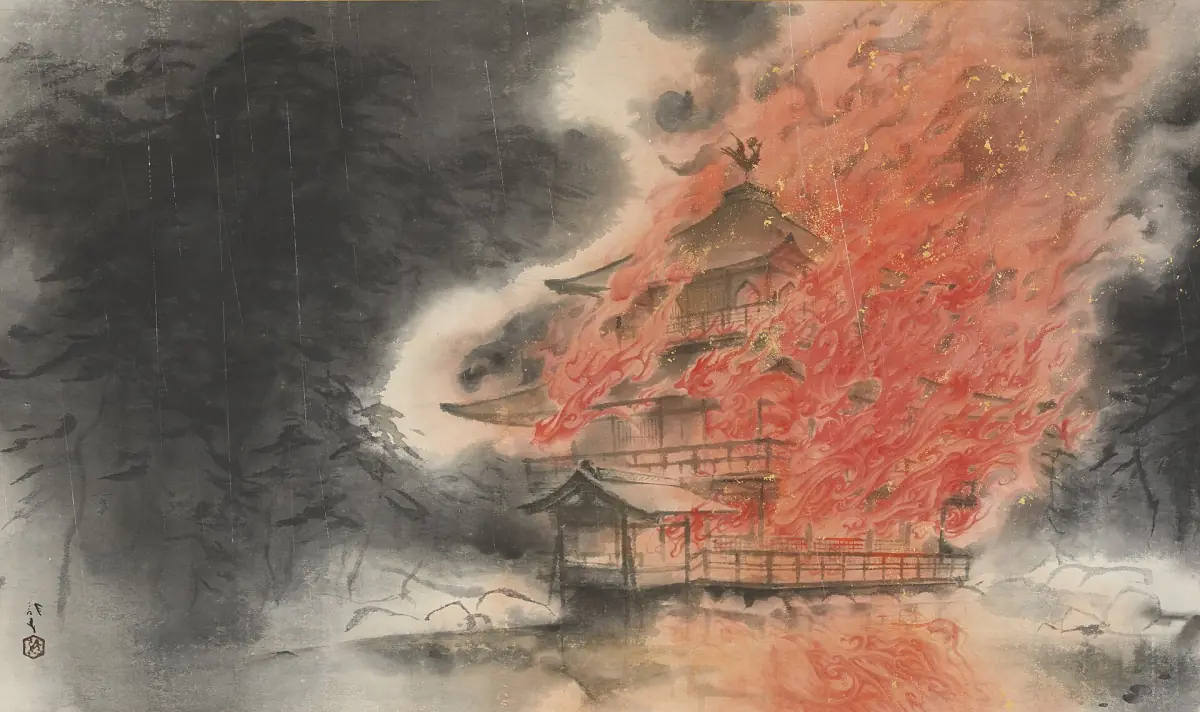
On 2 July 1950 the Golden Pavilion burned down completely. The fire was arson, set by a trainee monk of the temple.
A building that had stood since Yoshimitsu's lifetime was lost. The temple decided to rebuild the pavilion following the records of the Meiji repair rather than leave the site empty.
Rebuilding in 1955
Reconstruction took three years, based on the records from the Meiji dismantling repair. The new pavilion was finished in 1955 and rededicated on 10 October 1955. In 1958 the temple also repaired its abbot's quarters (hojo) and the large shoin hall.
In autumn 1987 the pavilion was restored again: the lacquer and gold leaf were renewed, along with the ceiling paintings and the statue of Yoshimitsu.
World Heritage and protected garden
In 1994 Kinkaku-ji became part of the UNESCO World Heritage Site "Historic Monuments of Ancient Kyoto (Kyoto, Uji and Otsu Cities)", which has 17 components in Kyoto, Uji and Otsu. The garden of Rokuon-ji is also protected nationally as a Special Historic Site and a Special Place of Scenic Beauty. See how to walk it on our Kinkaku-ji garden page.
Mishima's novel The Temple of the Golden Pavilion
The fire inspired a well-known Japanese novel. Yukio Mishima's "Kinkaku-ji", published in English as "The Temple of the Golden Pavilion", appeared in 1956 from the publisher Shinchosha. It is a work of fiction. Its narrator is an invented character, and the novel should be read as literature, not as a record of what happened in 1950.
Many visitors arrive having read the book. The history is easier to follow if you read up before your visit or join a guide who explains it.
Kinkaku-ji timeline
| Year | Event |
|---|---|
| 1224 | Saionji Kintsune's temple on the site is dedicated |
| 1358 | Ashikaga Yoshimitsu is born |
| 1394 | Yoshimitsu hands the shogunate to Yoshimochi |
| 1397 | Work begins on the Kitayama villa |
| 1408 | Imperial visit, death of Yoshimitsu; the villa becomes a Zen temple |
| 1904 | Meiji period dismantling repair completed |
| 1950 | Pavilion destroyed by arson on 2 July |
| 1955 | Rebuilt pavilion rededicated on 10 October |
| 1956 | Yukio Mishima's novel is published |
| 1987 | Lacquer and gold leaf renewed in autumn |
| 1994 | Part of the UNESCO World Heritage Site |
For most visitors with an interest in history, a guided visit of 90 minutes or so is the easiest way to connect these dates with what you see on the garden path.
Seeing the history on your visit
A visit is a walk through the garden. You see the pavilion across the pond, then follow the path through the grounds, with steps after the pavilion, past spots such as the Sekka-tei tea house and the Fudo-do. Plan on seeing the pavilion from outside; the interior is not part of a normal visit. Entry is ¥500 for adults including high school students and ¥300 for elementary and junior high school students (as of 2026), and the temple is open daily 9:00 to 17:00. Details on our entry fee and opening hours page.
Kyoto's history continues all around the temple. For the wider story of the city, see the history of Kyoto. Ginkaku-ji, where Ashikaga Yoshimasa began his Higashiyama villa in 1482, offers a contrast: compare both on our Kinkakuji and Ginkakuji page.
Kinkaku-ji history: frequently asked questions
Is the Golden Pavilion original?
No. The original pavilion burned down on 2 July 1950. The current building was rebuilt over three years and rededicated on 10 October 1955, based on records from a Meiji period repair. The gold leaf was renewed in 1987.
Who built Kinkaku-ji?
The shogun Ashikaga Yoshimitsu began his Kitayama villa here in 1397. After his death in 1408 it became a Zen temple. Before that, Saionji Kintsune had a villa and temple on the site, dedicated in 1224.
Why did Kinkaku-ji burn down in 1950?
The fire was arson by a trainee monk of the temple. The pavilion was destroyed completely. Mishima's novel is based on the event but is fiction, not an explanation of the real case.
When was Mishima's Golden Pavilion published?
Yukio Mishima's novel "Kinkaku-ji" was published in 1956 by Shinchosha. In English it is known as "The Temple of the Golden Pavilion".
Can you go inside the Golden Pavilion?
A normal visit is a walk through the garden, with the pavilion seen from outside. Plan on viewing it from the pond and the garden path.